
The Plan
Before you set anything up, answer three questions:
- What categories of documents do I have?
- What information do I need from each category?
- How long do I need to keep each document?
There are more questions, of course, but these three are enough to get started.
Categories
Section titled “Categories”Start with the first question. A category is a group, or type, of documents. Documents in the same category look roughly alike and carry similar information.
When Clara asked herself this question, she found three kinds of documents:
- Supplier Invoice
- Customer Invoice
- Hygiene Record
Metadata
Section titled “Metadata”Metadata is information about a document, such as who issued an invoice and when. Once you roughly know which categories your documents fall into, decide which information you need from the documents of each category.
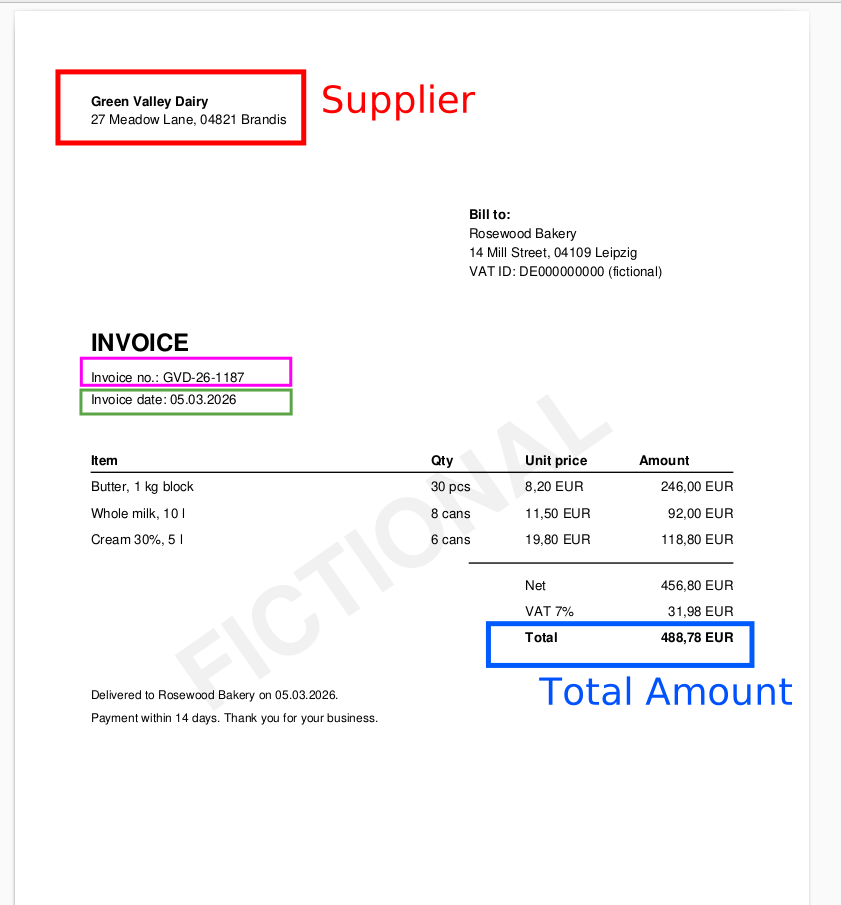
From supplier invoices, Clara needs the Supplier (who issued the invoice), the Invoice Number, the Invoice Date (when the invoice was issued) and the Total Amount (the total of the invoice).
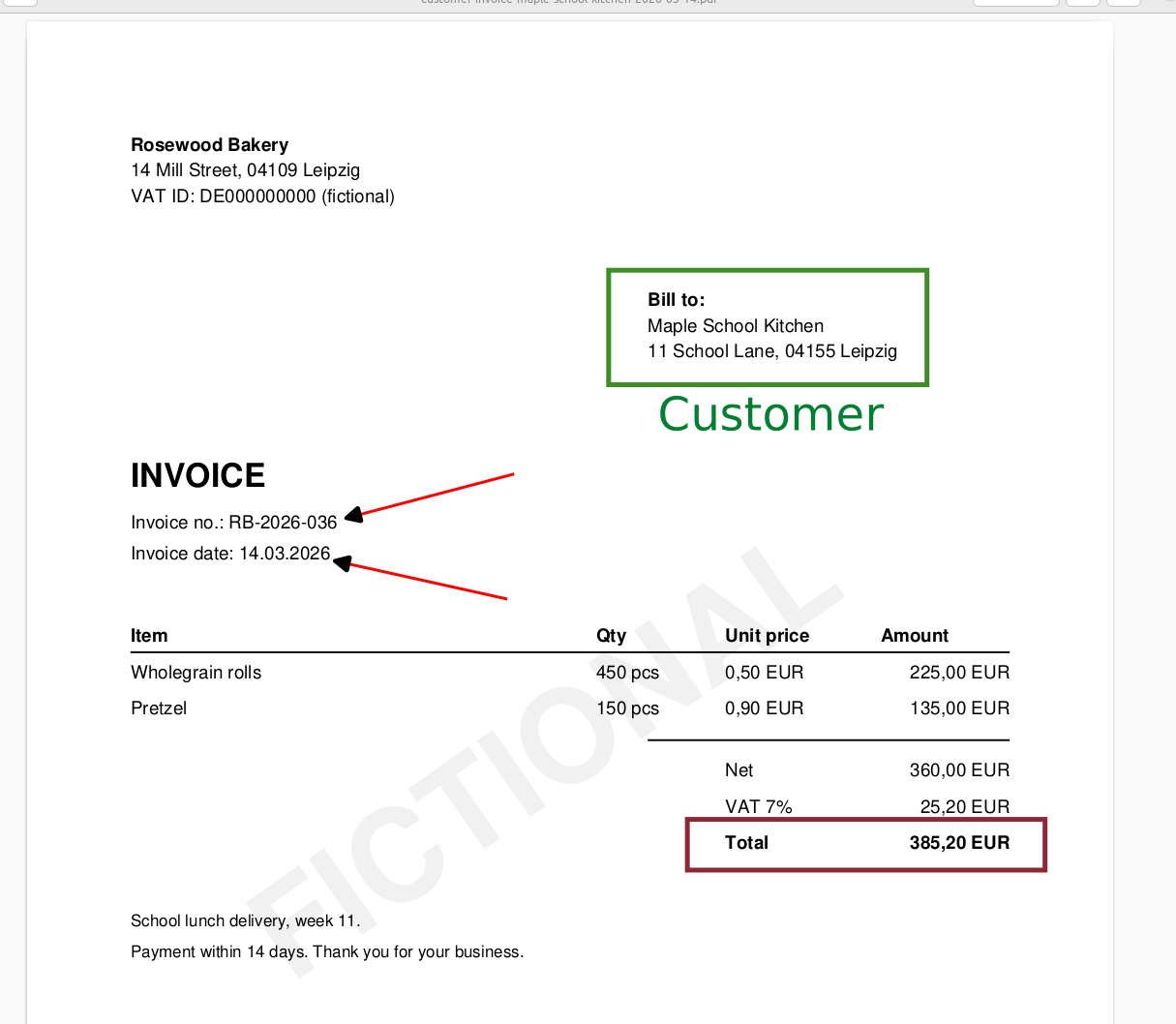
Customer invoices are similar: Clara needs the Customer, Invoice Number, Invoice Date and Total Amount.
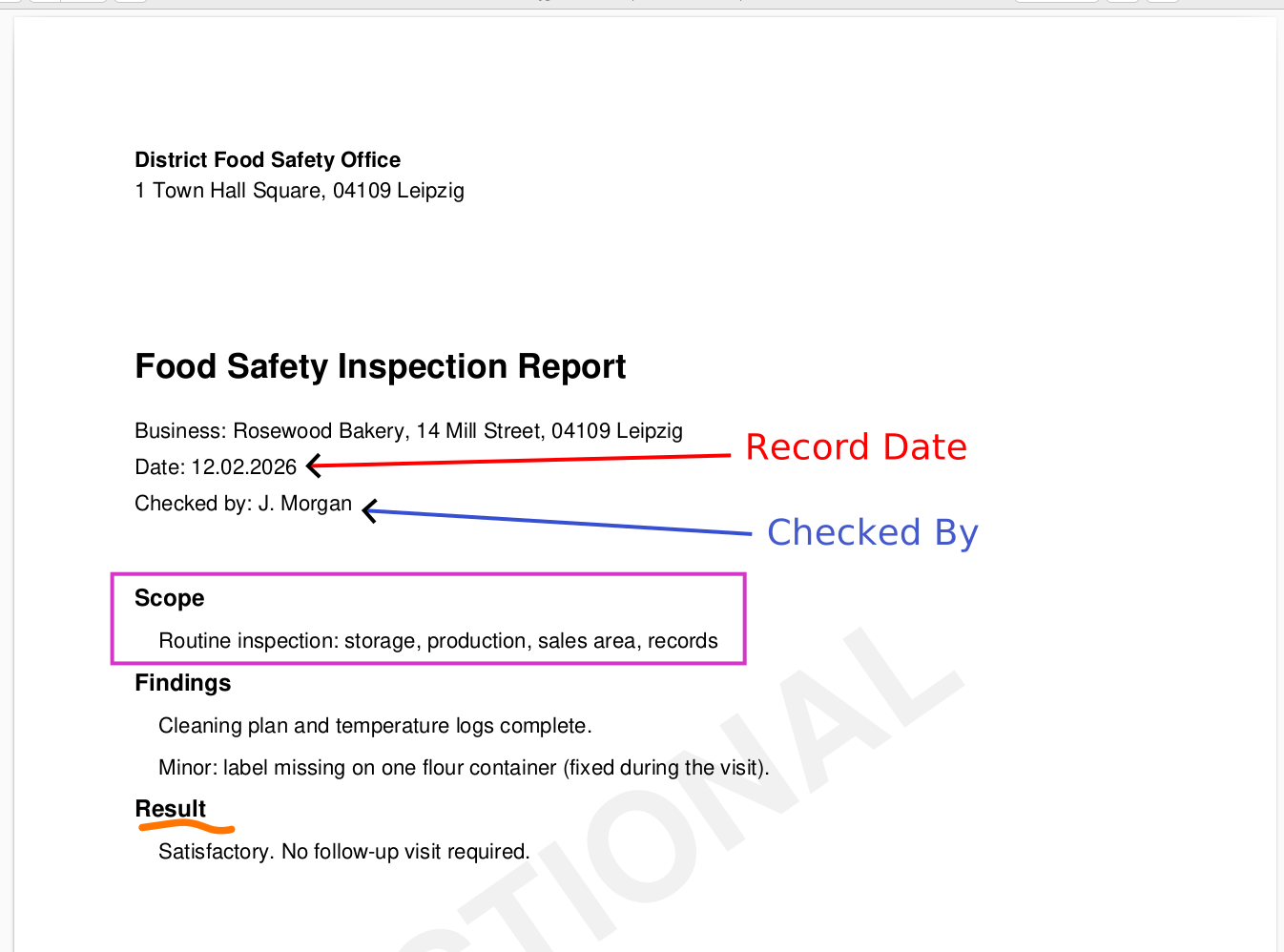
From hygiene records, Clara wants to know the date of the record (Record Date), who did the check (Checked By), which topics it covered (Topics), and the outcome of the check (Results): passed, passed with remarks, follow-up needed or failed.
Clara writes down the metadata for each category in a table:
| Category | Metadata |
|---|---|
| Supplier Invoice | Supplier, Invoice Date, Invoice Number, Total Amount |
| Customer Invoice | Customer, Invoice Date, Invoice Number, Total Amount |
| Hygiene Record | Record Date, Checked By, Topics, Results |
Data Retention
Section titled “Data Retention”Nobody wants to keep documents forever: they take up space, and old personal data is a liability. Some documents must be kept for 3 years, others for 10 years. This is the retention period: how long you must (or want to) keep a document. In many countries, the law sets a minimum period.
Rosewood Bakery is in a fictional country whose law requires invoices to be kept for 10 years and hygiene records for 3 years.
Here is Clara’s plan for structuring the bakery’s documents:
| Category | Metadata | Kept for |
|---|---|---|
| Supplier Invoice | Supplier, Invoice Date, Invoice Number, Total Amount | 10 years |
| Customer Invoice | Customer, Invoice Date, Invoice Number, Total Amount | 10 years |
| Hygiene Record | Record Date, Checked By, Topics, Results | 3 years |
Cabinet
Section titled “Cabinet”A cabinet in Papermerge is the digital equivalent of a physical filing cabinet. It also decides who can see the documents in it.
Rosewood Bakery has just three people who will use Papermerge. With only three categories, Clara does not want to complicate matters, so she wants the simplest setup possible: all three of them, Clara, Martin and Ella, will have full access to all documents.
All three categories will be created as company-wide (they belong to the company, not to one person) and will file their documents into one cabinet, Rosewood Bakery.
Next: Setup.